Table of Contents
ToggleHalloween living room decor doesn’t require professional staging or a bottomless budget. With strategic lighting, a cohesive color palette, and a mix of purchased and DIY props, any living room can become a genuinely eerie gathering space. This guide walks through eight proven decor ideas, from mood-setting lighting to statement-making props, that transform a standard room into something guests won’t forget. The focus here is practical execution: what actually works, what fits most layouts, and where to cut costs without sacrificing impact.
Key Takeaways
- Master Halloween living room decor by prioritizing strategic lighting—dim overhead lights and layer warm accent lighting, LED candles, and uplighting in orange, purple, or cool white to create eerie shadows and ambiance.
- Commit to a tight color palette of orange, black, and purple plus metallics and neutrals to prevent visual chaos and ensure your Halloween living room decor reads as intentional rather than cluttered.
- Maximize wall and window space with removable silhouettes, spiderweb draping, backlit gauze, and fabric drapes that create dramatic effects without requiring floor space or permanent installation.
- Invest in one or two statement pieces like a life-size skeleton or skull display positioned in corners or partially obscured by furniture to anchor the room and spark conversation.
- Layer textiles strategically—throw pillows, blankets, dark rugs, and fabric accents—to add depth, shadow play, and a cozy haunted-house atmosphere at minimal cost.
- Build impressive Halloween living room decor on a budget using dollar-store basics, thrift-store finds, DIY paper crafts, and homemade lighting from string lights and PVC pipes, then repurpose elements year after year.
Create an Eerie Lighting Atmosphere
Lighting is the foundation of Halloween ambiance. Standard overhead lights flatten the room and kill any spooky feel, so the first step is to dim or turn them off entirely.
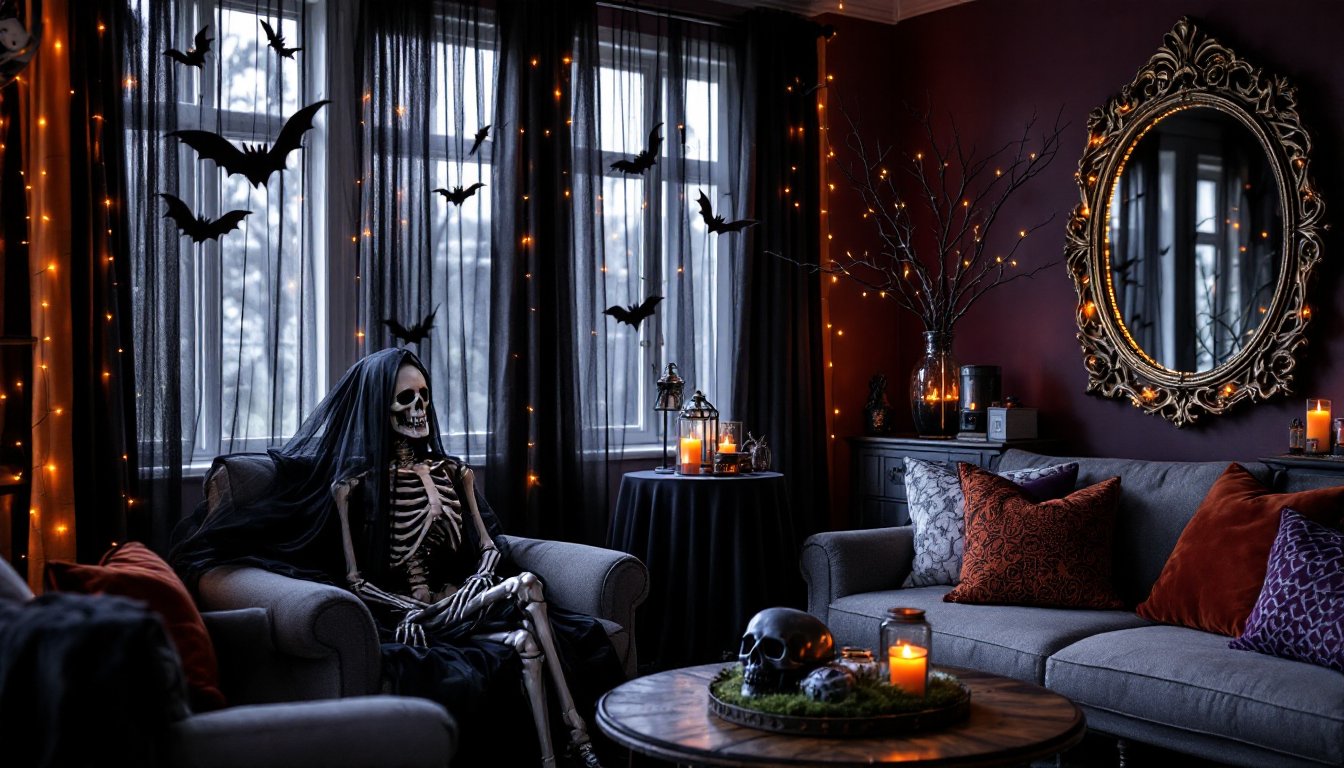
Start with warm, low-level accent lighting: string lights, uplighting, or LED spotlights in orange, purple, or cool white. These create pockets of shadow that naturally feel unsettling. Position lights to shine upward from corners or behind furniture, this reverse lighting casts eerie shadows on walls and ceiling, mimicking candlelight or distant sources.
Candles (real or battery-operated LED) reinforce the effect and add flicker without heat risk. Cluster them on mantels, side tables, or windowsills in varying heights. LED candles with real-flame flicker simulation are safer and last longer than votives.
If the room has recessed ceiling fixtures, swap bulbs to dimmable warm white (2700K) or plug in dimmable smart bulbs. This gives control over intensity throughout the evening. Avoid cool white or daylight temps (5000K+), they feel clinical, not creepy.
For maximum effect, stage one corner as a focal point: a prop, display, or architectural feature lit from below or behind. A skull, skeleton, or mirror with backlighting draws the eye and signals the room’s intentional aesthetic.
Master the Color Palette: Orange, Black, and Purple
A tight color palette prevents visual chaos. Halloween’s trio, orange, black, and purple, works because they’re naturally high-contrast and read as “spooky” instantly. Introducing every color on the spectrum dilutes impact.
Use black as the anchor: it absorbs light, creates drama, and grounds the design. Deploy it on a focal wall (painter’s tape for chevrons or stripes), or drape black fabric over furniture, shelving, or doorways. Black tablecloths or runners ground displays.
Orange brings warmth and visibility. Think burnt orange, not neon, it’s more sophisticated and photographs better. Use it in accents: throw pillows, string lights, or trim on wall displays. A single accent wall in matte orange (sherwin-williams “Rustic Red” or similar) anchors the room without overwhelming it.
Purple deepens the mood. Deeper purples (plum, aubergine, midnight) feel more refined than bright violet. Scatter purple through smaller decor: candles, throws, fabric accents, or lighting gels.
Stick to these three plus metallics (bronze, copper, silver) and neutrals (gray, white, natural wood). This discipline makes the room feel intentional rather than like Halloween exploded.
Decorate with Haunted Wall and Window Displays
Walls and windows are prime real estate and don’t require floor space.
Wall hangings are simple to install and high-impact. Use removable adhesive strips or painter’s tape to mount cardboard cutouts, paper silhouettes, or fabric drapes. Black tissue-paper cutouts of bats, spiderwebs, or haunted trees are inexpensive and effective. For a more polished look, print or purchase vinyl decals in silhouettes, they’re repositionable and leave no residue.
Spiderweb draping is a classic for good reason. Stretch white or black polyester webbing across corners, around doorframes, or along shelves. It reads instantly as “spooky” and costs under $10 per roll. Add plastic spiders (some have realistic texture, others are cartoony, choose based on your tone).
Windows benefit from backlighting effects. Hang gauze or cheesecloth inside the frame and light it from behind with an LED strip or table lamp. Silhouettes of witches, ghosts, or ghouls become more menacing when backlit. Alternatively, print oversized window clings of haunted mansions or zombie hands and apply them directly to glass.
Fabric drapes over existing artwork or mirrors transform the space without damage. Use black, deep purple, or charcoal fabric hung with painter’s tape or removable hooks. This softens lines, creates folds that play with shadow, and visually expands vertical space.
Add Statement Pieces: Oversized Props and Figures
A well-placed prop anchors the room and becomes the conversation starter.
Life-size skeletons or zombies are worth the investment if the budget allows. Brands like Spirit Halloween or HomeGoods stock pre-built, articulated figures (typically $60–$150). Position one seated in a chair, standing in a corner partially shrouded in fabric, or emerging from behind the couch. The key is partially obscuring it, fully visible props read as decoration, but ones that merge with furniture or shadow feel more immersive.
Skull displays work in any corner. A skull on a stand can be life-size or smaller: nest it in moss, surround it with candles, or position it on a bookshelf as a focal point. Many are resin and durable enough to reuse for years.
Animatronic or moving props (reaching arms, talking skulls, motion-activated sounds) escalate impact but require floor space and outlets. These work best in a corner or alcove where they don’t block traffic. Test motion-activation range beforehand, some trigger too easily and annoy guests.
Cauldrons, treasure chests, or cages provide smaller focal points and can double as candy bowls or storage. A black or gold cauldron with dry ice fog (if safe to manage) becomes the room’s centerpiece.
Budget tip: Thrift stores often carry affordable props in October, and post-Halloween sales (November 1st onward) are where deals happen.
Layer in Textiles and Seasonal Accents
Textiles are quick wins, throw a black fringed tablecloth over a side table, swap throw pillows to deep purple or orange, or drape a sheer black fabric over a lampshade to cast shadowy patterns.
Area rugs anchor seating areas. A dark rug (black, charcoal, or deep burgundy) defines the space and hides the everyday floor. Layer a smaller orange or patterned runner on top for visual interest.
Throw blankets over sofas and chairs add texture and a cozy haunted-house feel. Chunky knit or velvet in black, purple, or burnt orange works. Drape them casually, precision reads sterile.
Seasonal accents include:
- Autumn branches in tall vases (spray-painted black or left natural)
- Pumpkins (real, foam, or ceramic) in clusters of odd numbers
- Candles in glass hurricanes to prevent drafts
- Vintage-looking bottles or apothecary jars labeled with spooky names (“Eye of Newt,” “Witches Brew”)
- Framed vintage Halloween images or posters
Group accents in odd numbers (three pumpkins, five candles, seven branches) for visual balance. Mix heights and textures so displays don’t look flat.
Budget-Friendly DIY Decoration Tips
Halloween decor doesn’t require premium purchases. Here’s how to build atmosphere on a budget:
Paper and cardboard crafts cost pennies. Print bat or spider templates, cut them from black poster board, and tape them to walls or string them with fishing line. Hand-drawn or printed haunted house silhouettes feel homemade in a good way.
Dollar-store staples include black tablecloths, plastic skulls, artificial spiderwebs, and string lights. Quality varies, but for under $30, you can stock a surprising amount of decor.
Thrift-store finds are goldmines. Old mirrors, portraits, ornate frames, and furniture can be spray-painted black or incorporated as-is. A painting of a landscape can become “spooky” with a black frame and strategic lighting.
DIY lighting: String warm-white Edison bulbs through PVC pipe frames and tuck them behind furniture for uplighting. Or wrap string lights around branches in a vase. At $10–$20, these create custom effects.
Fabric draping: Old curtains, bedsheets, or burlap from fabric stores (often $3–$5 per yard) become wall coverings, window displays, or prop draping. Black or gray is most versatile.
Paint and tape: Black painter’s tape creates wall patterns: a $15 can of spray paint transforms thrifted items from boring to witchy. Stick to matte finishes for a cohesive look.
Avoid waste: Repurpose elements year to year. Cardboard cutouts, fabric, lights, and candles outlast a single season with basic storage.
Conclusion
Transform a living room into a haunted space by layering lighting, color, and props intentionally. The formula is simple: dim overhead light, add warm accent lighting, commit to orange-black-purple, drape walls and windows, anchor with one statement piece, soften with textiles, and fill gaps with budget-friendly accents. Start early (mid-October), prioritize the most visible area first, and don’t overload, restraint reads more credible than clutter. With these ideas in place, guests will feel the shift the moment they enter the room.